Menu

For the love of the game

IMG_0984When fans of the Golden State Warriors downloaded the team’s new app to their android phones, they got more than they bargained for.  While they were now able to keep up with the latest team news, their private conversations were at risk of being heard.  That’s because the technology in the app interacts with the stadium’s Signal360 beacons which are used to send fans ads and promotions based on where they are in the stands.  Those beacon signals are received by the phone’s microphone, even when the app is not in active use, and, as a result, the user’s conversations can be constantly and continuously recorded and analyzed.  While the app requests permission to access the microphone, according to a new invasion of privacy lawsuit filed against the team by users of the app, the details about how the team will be using this permission are vague and ambiguous.   Security Tip:  before installing any program, read the terms of use/service clauses carefully, and ask yourself do I really need this.

http://www.law.com/sites/almstaff/2016/08/30/mic-check-suit-says-warriors-app-uses-phone-to-listen-in-on-fans/?slreturn=20160731131334


Fighting CEO Fraud with Cybersecurity Training

spear phishing the CEO

Corporate Spear Phishing on the Rise

No longer fooled by emails seeking help from friends stranded overseas or mugged in New York, scammers are looking for new ways to separate you from your money. And this time, they are thinking big—C-Suite big.  The FBI estimated that from October 2013 through December 2014, companies lost a total of $1.2 billion to CEO Fraud. The FBI blames internal security measures as the number one reason for these losses.

In one instance, the director of accounting for a company in Texas wired $480,000 to an account in China because he received an email from the “CEO” directing him to do it.  However, it was an individual posing as the CEO. The scammer had hacked into the company’s server and spent months learning how the company worked and the relationship between the CEO and the director of accounting. He then emailed the director of accounting and made what appeared to be a normal request in the ordinary course of its business. But for the scammer’s audacious request for $18 million to be wired to the same account a few weeks later, it might have continued unnoticed.

In another case, a magazine publisher lost $1.5 million. The accounting executive of the company sent the wire based on an email from the “CEO,” but prior to sending the second requested transfer, he asked the CEO if he had truly made the request, only to find that he did not.

Because these scams are targeted (known as spear phishing), they appear to come from trusted individuals, contain requests that appear normal, and are often not caught by spam filters because they are not mass-mailed.

In addition to standard internal control features for wire transfers that can and should be implemented, below are three practice pointers to help prevent this from happening to you and mitigating the loss if it does.

Training

Employees need to be trained in the ways in which scammers operate. Typically these scammers will purchase a list of emails from the Dark Web and begin sending phishing emails containing malicious attachments (or links to infected websites) to hundreds of addresses.  Once an unsuspecting employee opens the attachment (or clicks on the link) and the malware is installed, the scammer has access to the company’s network (at least as far as that employee’s computer can see into it).  Depending on the level of access, the scammer may move on if nothing can be exploited or next if the computer has access to company data/emails/etc.  Once the scammer decides to act, he may wait until the CEO/executive is away from the office, or simply alter the email address slightly to trick the non-observant receiver. For instance, jsmith@american.com may become jsmith@amer1can.com.

Proper training to prevent these issues include instructing employees not to open email attachments from a sender the employee does not know or recognize.  In addition, employees need to be instructed to look for variations in email addresses when being asked to complete tasks that are critical to the company’s business, such as releasing sensitive data, or giving access to portions of the company server reserved to departments other than the requesting party, and, most importantly, giving out the company’s money!

Many firms provide on-site and online training.

Cyber Security

Cyber security in the corporate world has become a yeoman’s task. As it pertains to CEO fraud, there are two primary fixes.  The first is to mandate company email accounts use two factor verification. If the CEO’s account is accessed from anywhere that is not a recognized, secure location, as designated by the user, a second verification method would need to be entered (either a code sent via text to the CEO’s phone or a pre-printed verification code).  This prevents a scammer from logging in from Starbucks.  The second is to institute an internal control to require more than one person’s authorization for money transfers or expenditures. Whether it be a wire transfer, check, debit, or other material financial transaction, the approval process should involve two individuals who are privy to the request, purpose, and related specifications.

Insurance Protection

Even the most vigilant company will still find itself a victim.  Traditional insurance policies contain some coverage for fraud protection, but as recent cases have shown, (AF Global Corp. v. Federal Insurance Company) they do not include this new type of fraud. Some of the policies will only pay a claim if the fraud was the result of a traditional negotiable financial instrument having been fraudulently forged or stolen, such as check fraud. Therefore, it is important to review your policies and work with your insurance company to provide a policy that includes coverage for monetary losses incurred by an electronic breach.

If you do have such coverage, your insurance company will need to follow the evidence to learn how the fraud took place.  Therefore, it is important to direct employees not to delete the emails related to the fraud. They emails can be examined forensically to help support your claim.

For more information relating to training, prevention, and investigation, contact the experts at Maragell at info@maragell.com.


Maragell Voted Best Computer Forensic Expert for Third Year in a Row and Best Investigators for 2016


For three years in a row, Maragell Corporate Investigations was voted one of the Best Computer Forensic Experts in the region by the readers of the New Jersey Law Journal.  AND, for the second time, we were voted one of the Best Investigators!
On behalf of our entire staff, thank you to all our law firm clients who voted for us and who, year after year, allow us to help them become the smartest attorneys in the room when it comes to electronic-based evidence.

Hiring in NY City? What you need to know about The Stop Credit Discrimination in Employment Act

Effective September 3, 2015, it became unlawful to conduct credit checks on nearly all potential and current employees if your business is located in the City of New York and you have more than four people on staff (including owners). As an employer, it is important to know the exceptions to this new limitation in the field of Human Resource Management.

What is actually prohibited?  According to the New York Commission on Human Rights (“NYCHR”), the governing body for this Ordinance, an employer cannot obtain a consumer credit report and use it in the hiring process unless the position falls within a specific list of exceptions.  According to the NYCHR, a consumer credit report refers to a credit score, credit accounts, bankruptcies, judgments, or liens whether obtained from a third party source or from the prospective employee directly.

While the Ordinance is being promoted by the City as the most stringent of its kind in the U.S., it does have its exceptions.   The onus is upon the employer to document the exception used to obtain a credit check.  The exceptions include:

  • Positions in which federal or state law requires credit background reports, such as FINRA licensed companies;
  • Police Officers, peace officers, or positions with a law enforcement or investigative function at the Department of Investigation (“DOI”);
  • Any positon subject to a DOI Background Investigation;
  • Positions requiring bonding under federal, state, or city law or regulation;
  • Positions requiring security clearance under federal or state law;
  • Non-clerical positions having regular access to trade secrets, intelligence information, or national security information;
  • Positions requiring responsibility for funds or assets worth $10,000 or more; and
  • Positions involving digital security systems.

It is important to consult an attorney or HR Specialist when making hiring decisions to determine whether or not you are complying with this, and other local, state and federal laws.  Before you do so, here are few practice points to get you started:

  • Research each position to determine if it fits within one of the exemptions—it may require you to develop a list of what is a trade secret or business intelligence that warrants extra HR security for that position and therefore, based on the assessment reached, exempts that hire from the Ordinance’s limitation;
  • Research your industry online to determine if there are federal or state guidelines that require credit history verifications for your industry;
  • Use Google and LinkedIn and other social media platforms when making your hiring decisions to the extent your state does not ban such research or prevent you from using protected activity found on these sites against the candidate (i.e. cannot use evidence of a person’s gender preference, marital status, age, etc. against them).
  • Create a log to document the exemptions used and the factual basis for each exemption claimed; and

The NYCHR has issued an official Guidance about the application of the Ordinance (see https://www1.nyc.gov/assets/cchr/downloads/pdf/CreditHistory-InterpretiveGuide-LegalGuidance.pdf) and it is expected it will continue to update the public on this topic via its FAQ page (see https://www1.nyc.gov/site/cchr/media/credit-check-law-frequently-asked-questions.page)

Maragell Voted Best Computer Forensics Expert Two Years in Row

Maragell Corporate Investigations was honored for a second year in a row by our peers in the legal community with a New Jersey Law Journal Best of 2014 medal for Best Computer Forensics Expert.  On behalf of our entire staff, thank you to all our law firm clients who voted for us and who, year after year, allow us to help them become the smartest attorneys in the room when it comes to electronic-based evidence.


New Jersey About Set to Restrict the Use of Criminal Records in Employment Settings

Despite pressure from business leaders and private detectives, the latest version of the New Jersey Senate Budget and Appropriations Committee’s “Opportunity to Compete Act” [SENATE, No. 2124] continues to impose restrictions upon New Jersey employers when advertising for, and interviewing, prospective employees as it applies to criminal records.

According to the Committee, it determined that “[r]emoving obstacles to employment for people with criminal records provides economic and social opportunities to a large group of people living in New Jersey, increasing the productivity, health and safety of New Jersey communities.” It also asserted “[c]riminal background checks by employers have increased dramatically in recent years, with estimates of 90 percent of large employers in the United States now conducting background checks as part of the hiring process…. and that [b]arriers to employment based on criminal records stand to affect an estimated 65 million adults in the United States with criminal records.”

Concerned by employment advertisements in New Jersey that include language regarding criminal records that either explicitly preclude or strongly dissuade people from applying, the Committee advanced its bill to the entire Senate to tackle these obstacles to employment.

If passed, the bill will preclude an employer (of 15 or more people) from requiring a job applicant to complete any employment application that makes any inquiries regarding the applicant’s criminal record during the “initial employment application” process. It will also preclude the employer from making any oral or written inquiry regarding an applicant’s criminal record during the initial employment application process. The term “initial employment application” means the period from advertisement through completion of initial interview.

If an applicant discloses any information regarding the applicant’s criminal record, by voluntary oral or written disclosure, during the initial employment application process, the employer may make inquiries regarding the applicant’s criminal record during the initial employment application process.

Notwithstanding the foregoing, employers should be aware that if the employment is for a position where a criminal history record background check is required by law, rule or regulation, or where an arrest or conviction by the person for one or more crimes or offenses would or may preclude the person from holding such employment as required by any law, rule or regulation, or where any law, rule, or regulation restricts an employer’s ability to engage in specified business activities based on the criminal records of its employees, the restrictions of the bill do not apply.

This last exception is key for many of our clients. For our non-regulated clients that send employees into regulated entities like banks, hospitals, and mortgage lenders, their contracts routinely contain clauses that require all employees to be screened and failure to produce proof of a background check can void the contract.

Hence, when advertising for a position, consider all job assignments the candidate may be obligated to fulfill. If a potential assignment is in a regulated industry where a background check will be needed, the bill’s restrictions on advertising and interviewing may not apply.

NJ State Bar Association Convention–Congratulations to our Winners

Borgata

NJ State Bar Convention

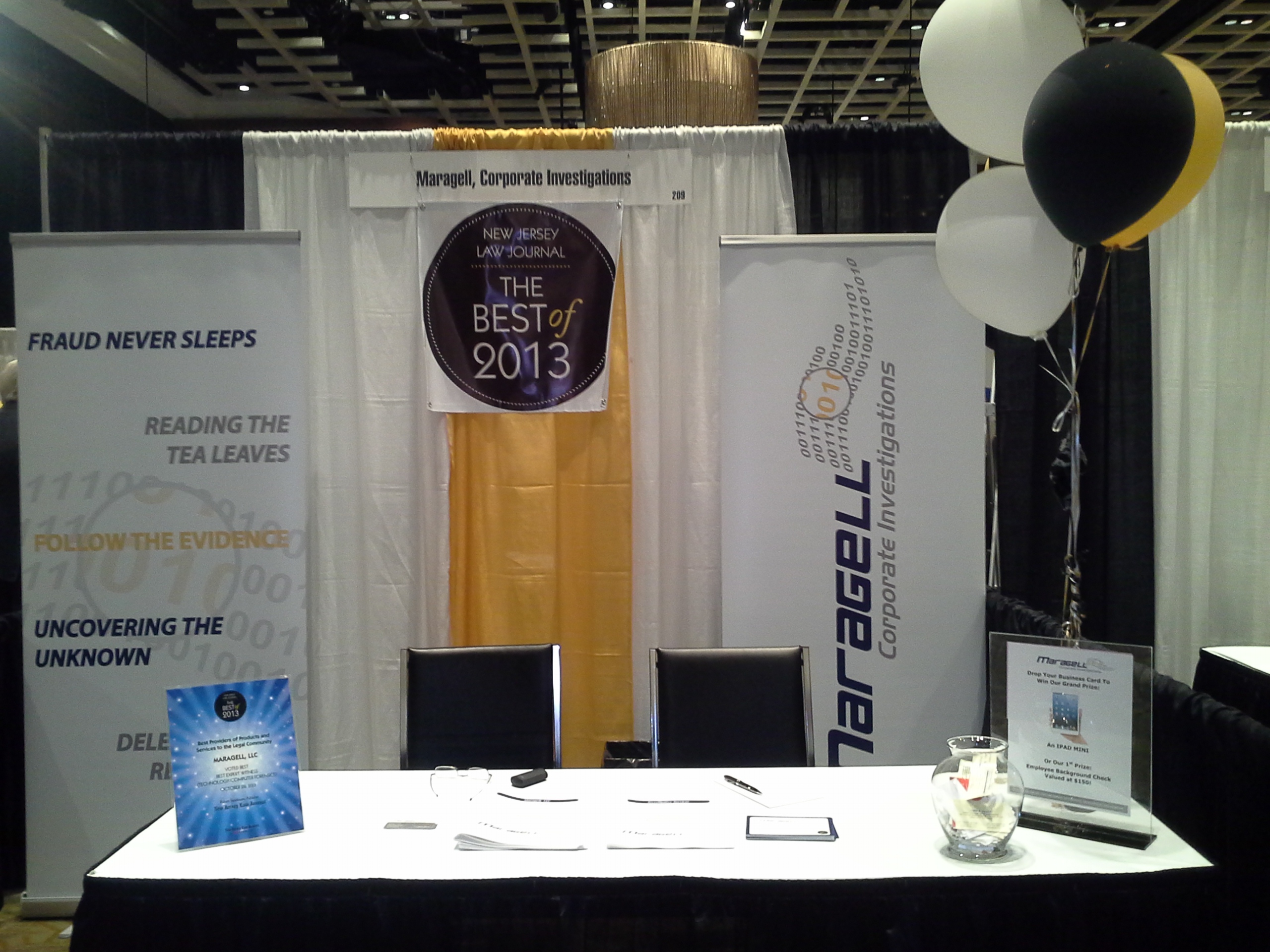
Maragell recently exhibited at the NJ State Bar Association Annual Meeting and Convention at the Borgata.

500+ guests stopped by to learn more about our computer forensic and investigative services, 160 entered the Treasure Chest prize giveaway for a chance to win a $100 gift certificate to the PI Gear online shopping mall, and 129 entered our fishbowl drawing for a chance to win an iPad mini and a free employee background check.

Congratulations to our winners:

Treasure Chest Prize–PI Gear Gift Certificate: Jonathan of NJ
1st Prize–$150 Background Check Certificate: Stephanie of Woodbridge, NJ
Grand Prize–iPad Mini: Doris of Freehold, NJ

We thank all our guests for taking the time to meet us and look forward to fulfilling their investigative needs.

Philly Inq.: Due Diligence Crucial in Investment Endeavors

fraud-is-everywhere


Jeffrey Brenner, Esq., NJLPI, was quoted in the Philadelphia Inquirer Business section on January 8, 2014 regarding J.P. Morgan’s settlement with the government over its dealings with Bernard Madoff.  Brenner, who investigated Madoff’s auditors in 2006, described how basic due diligence techniques revealed major red flags about Madoff’s operations, and how the same techniques can help today’s investors avoid becoming a victim.  Read the article here: http://www.philly.com/philly/business/20140108_Due_diligence_crucial_in_investment_endeavors.html

Maragell Presents on Electronic Evidence at Fraud Training Conference

Maragell Corporate Investigations’ Managing Principal Jeffrey Brenner, Esq., NJLPI, recently gave a presentation titled “You Found My Internet History? Tales from the Hard Drive” at the 21st Annual All-Day Fraud Training Conference hosted by the Philadelphia Area Chapter of the Association of Certified Fraud Examiners.

The presentation focused on six cases in which the early preservation and forensic analysis of electronic evidence changed the outcome of the litigation.

Judge Rosemary Ramsay names Jeffrey Brenner to be court-appointed computer forensic expert

On Friday, December 6, 2013, Superior Court Judge Rosemary Ramsay named Maragell’s Managing Principal, Jeffrey S. Brenner, Esq., NJLPI, as the court’s computer forensic expert in the case of former Parsippany Police Capt. James Carifi.  

According to published news reports, Carifi, who was already engaged in separate litigation with the Township of Parsippany, became the subject of a police internal affairs probe in which the Township claims he “manipulated” data on municipal computers and transferred police documents to his personal email.  These acts allegedly took place in late March, just before Carifi left the police department’s employ.

Rather than argue the motion for emergent relief, the Township and Carifi entered into a consent agreement under which Carifi will turn over his hard drive for preservation and imaging by Maragell.  Carifi will then be allowed to assert any applicable privilege he might have and withhold certain documents but must keep a “privilege log” of those items for review (and possible challenge) by the Township.